The Rise of Vibe Coding: Is No-Code Facing Its End?
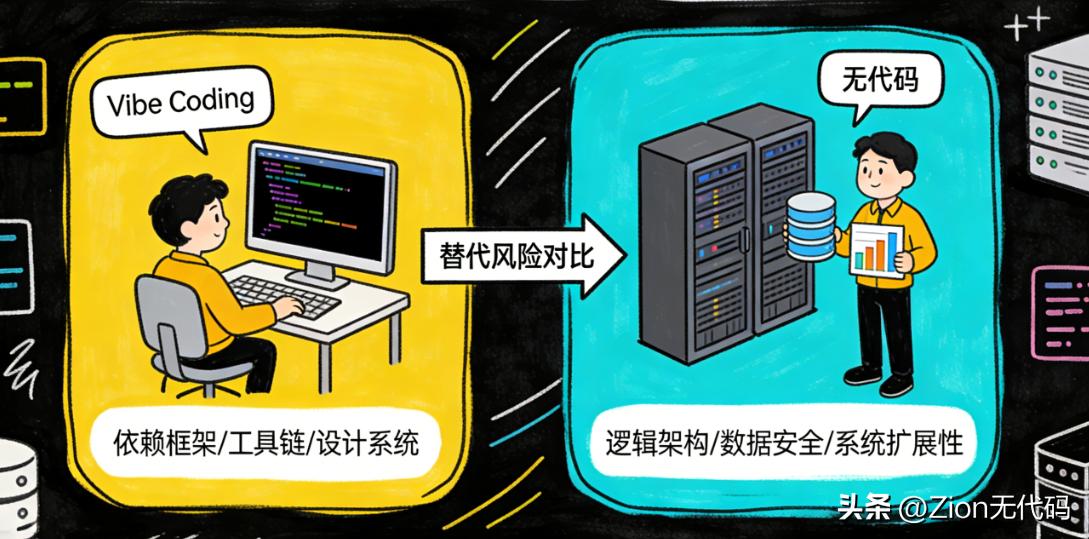
With the rapid rise of Vibe Coding technology, AI’s ability to generate code from natural language has become a norm in development. This raises the question: have no-code tools, which once focused on drag-and-drop product building, reached the end of their lifecycle? Will no-code truly be replaced by Vibe Coding?

Vibe Coding vs No-Code: Why Frontend is Easily Replaced, But Backend is the Core Barrier
To clarify the core differences between Vibe Coding and no-code, we must first analyze the essence of code development and the varying difficulties of AI replacing different development stages.
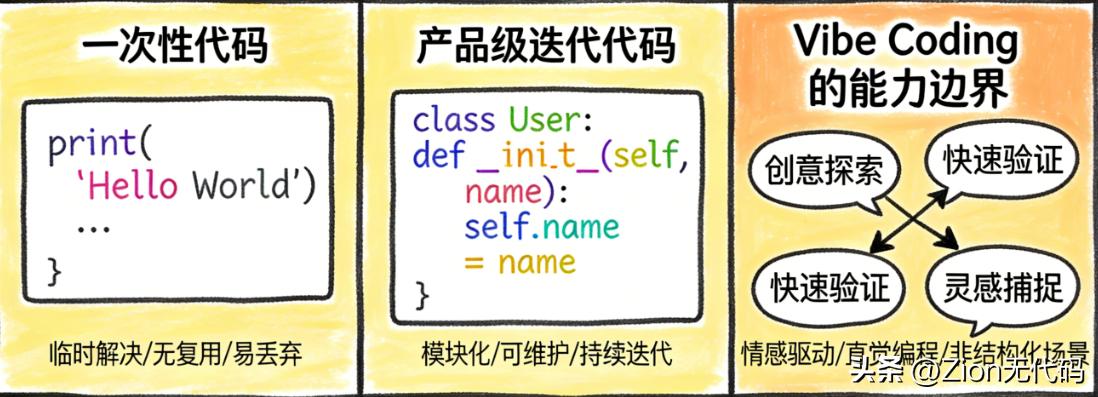
One-Time Code vs Product-Level Iterative Code: The Capability Boundaries of Vibe Coding
From the essence of code development, code can be divided into two main types, each requiring different tools:
One-Time Code: Designed for specific problems without the need for generality or long-term maintenance, such as batch renaming files or simple lottery scripts. Vibe Coding excels in generating usable code in one line, with complete context, and is currently the most mainstream application of Vibe Coding.
Product-Level Iterative Code: This type is reusable and requires continuous iteration and optimization, forming the core of most commercial products. Such products need to be modified based on market feedback and user needs. Vibe Coding struggles in iterative scenarios due to context forgetting and recall precision issues, making it difficult to fully restore a system’s complete configuration and operational logic.
The Essential Differences Between Frontend and Backend: The Vast Gap in AI Replacement Difficulty
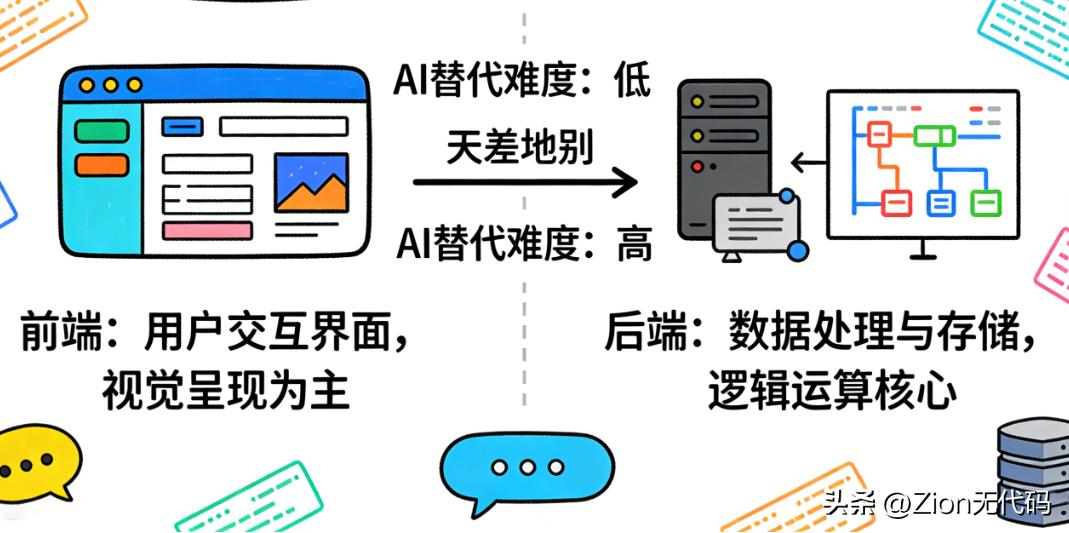
In addition to code types, the fundamental differences between frontend and backend development determine the varying difficulties of being replaced by Vibe Coding:
Frontend Development: Quick feedback, highly visual, no persistent state, and minimal inter-component interaction. If something goes wrong, refreshing the page restores it, and the generated results are easy to evaluate. This straightforward development work is where Vibe Coding excels and is currently the most thoroughly replaced segment by AI.
Backend Development: Highly abstract, long feedback cycles, persistent states (databases), and deep inter-module interactions. Mistakes can lead to irreversible business losses, and non-technical individuals find it hard to assess whether AI-generated backend logic meets business needs. This is also the area where Vibe Coding finds it challenging to penetrate, representing a core survival barrier for no-code tools.
The Ambiguity of Natural Language: Why AI Cannot Fully Restore Product Intent
Even as Vibe Coding technology evolves, it cannot resolve a core issue: the ambiguity and vagueness of natural language. Human product intent heavily relies on shared context between the parties involved in a conversation. The same statement can have completely different meanings in different contexts, which is the essence of “a thousand Hamlets in a thousand people’s eyes.” If natural language could express all needs precisely and unambiguously, there would be no need for unambiguous formal languages (code).
This is akin to collaboration between companies and outsourcing teams. Even if the outsourcing team has strong technical capabilities, it cannot fully restore the core intentions of the client, as there will always be an information gap. Vibe Coding acts like an efficient, low-cost outsourcing team that can quickly complete basic development but cannot precisely match all of the user’s product intentions. The core value of no-code tools like Zion is to provide users with a visual canvas and controllable editing capabilities. After AI completes the basic setup, users can accurately modify every detail, often more efficiently and precisely than requesting changes from AI.
Zion’s Core Competitiveness: Survival Rules in the Vibe Coding Era
In the face of the comprehensive impact of Vibe Coding on the industry, Zion maintains its core competitiveness by deeply focusing on backend capabilities since its inception, creating irreplaceable core advantages over Vibe Coding and similar no-code platforms.
The Only No-Code Platform Retaining Database Transactionality, Solving Core Data Consistency Issues
For commercial products, an unattractive frontend interface only affects user experience, while backend data errors directly lead to business losses—such as overselling during flash sales, incorrect transaction data, or abnormal inventory deductions.
Zion is one of the few no-code platforms that fully retains the abstraction of database transactional operations, supporting essential capabilities like foreign keys and data constraints to ensure data consistency from the ground up. For instance, in a transfer scenario, the payer’s deduction and the payee’s addition must occur simultaneously. If unexpected issues arise, such as network disconnections or server crashes, transaction guarantees will roll back the entire operation, preventing one-sided deductions or additions. In contrast, most Vibe Coding backend solutions on the market, based on Supabase, Firebase, or MongoDB, typically lack transaction guarantees, with many logics written directly in the frontend, leading to data anomalies during network outages.
Targeting Non-Technical Founders: Building an Understandable and Controllable Product Development System
Zion’s core positioning has always been to provide product development tools for non-technical founders, aiming to enable those who cannot write code to understand, control, and iterate their products, creating a clear distinction from Vibe Coding.
Vibe Coding users fall into two extremes: one group needs only one-time code and does not care about code quality or maintainability, while the other consists of professional developers who can understand, review, and control AI-generated code. For non-technical founders who cannot write code, the code generated by Vibe Coding is a black box; even with AI translation, it cannot fully eliminate the technical barrier or allow them to assess whether the code has vulnerabilities or meets their business needs.
Zion’s visual abstraction layer enables non-technical individuals to clearly understand the business logic, data flow, and workflow configurations of their products, achieving complete control over their products. This is the core reason why non-technical founders will continue to choose Zion in the Vibe Coding era.
High Availability Architecture to Meet the Scalability Needs of Commercial Products
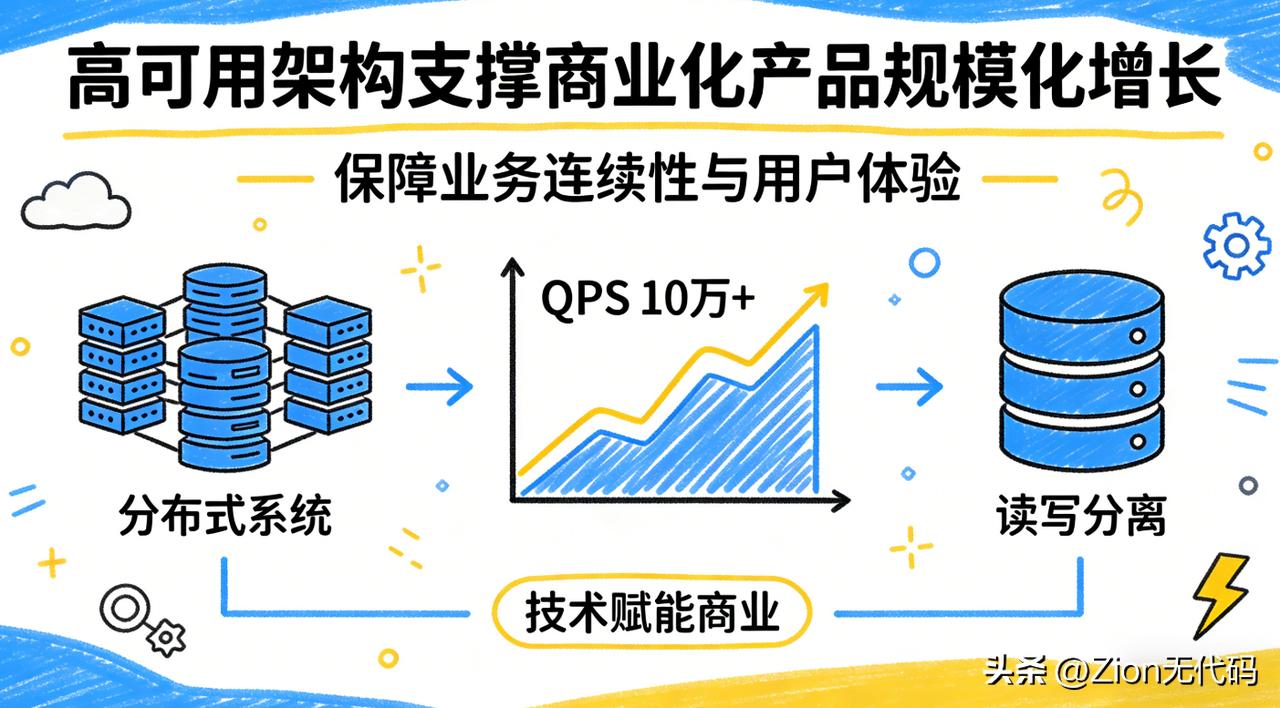
Many no-code products can only support small demo projects. Once user scale increases or concurrency rises, systems often crash or data anomalies occur, which is a core reason for the frequent failures of no-code projects in the industry.
Zion’s architecture is deeply optimized for the growth needs of commercial products: it currently supports up to 920,000 daily active users per project, can handle millions or tens of millions of data table rows, and supports hundreds of concurrent operations per second, placing it at the forefront of the no-code industry. While it cannot support projects with over 1 million daily active users or billion-row single tables, it fully covers the entire commercial needs of non-technical founders from 0 to 1 and from 1 to 10.
Zion No-Code’s Precise Positioning: Who/What Scenarios are Best Suited for Use?

The core user group for Zion No-Code meets three main characteristics:
- They wish to have complete control over their products, do not want to be hands-off, and possess curiosity, patience, and basic business abstraction abilities.
- They are building reusable, iterative commercial products that address a class of user needs rather than a single issue, requiring continuous iteration and optimization based on market feedback to realize commercial value.
- Professional developers have more efficient development methods in the Vibe Coding era, while non-technical founders are Zion’s core service group.
Currently, Zion has covered various scenarios, including store ordering mini-programs, knowledge payment platforms, warehouse management systems, AI dialogue generation platforms, and social platforms. Many non-technical founders have used Zion to build their products from 0 to 1, even achieving annual revenues of millions.
Digital Sovereignty: How Zion Breaks the Binding Dilemma of No-Code Platforms
For entrepreneurs, the backend logic and user data of a product are core assets. Many no-code platforms create strong binding “cages” through closed designs, making users reluctant to choose no-code solutions.
To address this pain point, Zion has adhered to the principle that “tools are scaffolds, not cages” since its design inception, fully supporting users in gradually detaching from the platform step by step and module by module, completely alleviating concerns about platform binding:
Fully Replaceable Frontend: Users can embed code components into Zion frontend projects, gradually replacing modules or entirely abandoning Zion’s frontend by integrating Vibe Coding or self-developed frontends with Zion’s backend API.
Human-Readable APIs: All of Zion’s APIs are designed to be human-readable in terms of input and output types, making it easy for AI integration and for users to understand business logic and complete system migrations, contrasting sharply with the closed binary APIs of similar platforms.
Complete Data and Structure Export: Users can export all business data at any time, supporting real-time data synchronization through database triggers and Webhooks. Table structures and behavioral flow logic can be downloaded with one click and directly imported into AI-generated corresponding code, significantly reducing migration costs.
Support for Gradual Migration: Users do not need to replace the system all at once; they can gradually migrate business logic to external systems, interfacing with Zion’s foundation through APIs, flexibly choosing suitable technical solutions at different stages of business development.
AI Fully Empowering Zion: Starting with Small Functions to Truly Lower the No-Code Usage Threshold
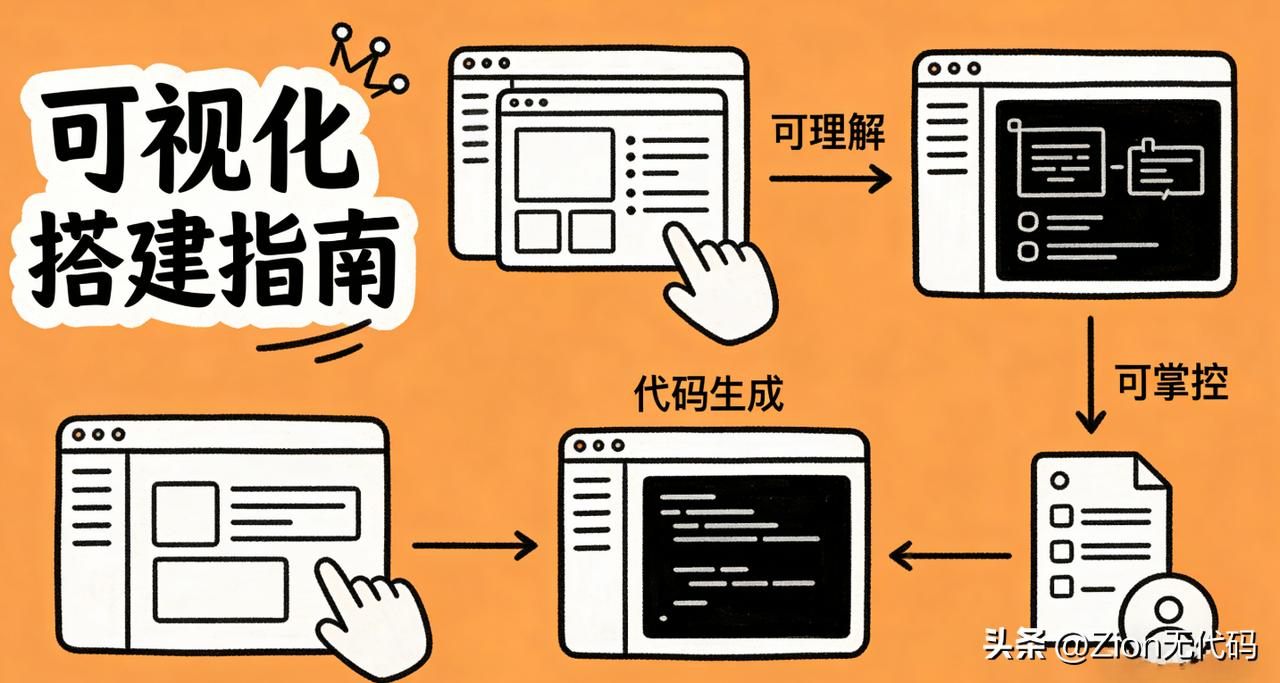
In the face of the AI wave, Zion has not chosen to create a “large and comprehensive AI agent that generates complete projects in one step” but instead focuses on high-frequency, trivial scenarios in no-code usage, gradually embedding AI capabilities throughout the product chain, allowing AI to become a genuine efficiency tool for users rather than replacing them.
Currently, the AI capabilities implemented by Zion include:
Intelligent Database Structure Generation and Optimization: Users can input business needs, and AI will generate a standardized and reasonable database table structure, with quality exceeding that of 60% of professional backend developers, while also supporting intelligent modifications and structure interpretation, allowing users to learn the core logic of database design through this process.
Intelligent Data Binding Recommendations: For the binding configuration between frontend pages and data, AI can intelligently recognize field meanings and complete matches with one click, eliminating the need for users to select each one manually, significantly reducing tedious configuration workload with accuracy even surpassing manual operations.
Intelligent Field Naming and Standardization: For the high-frequency field naming issues in no-code configurations, AI can automatically identify field purposes and generate standardized, understandable names in Chinese, addressing the naming pain points of non-technical users.
Intelligent Behavior Flow Configuration: For complex behavior flows with multiple fields and nodes, AI can complete field matching and configuration with one click, with batch filling capabilities to be launched later, thoroughly solving the tedious issues of behavior flow configuration.
AI Price Calculator: Users can input product needs, user scale, and business scenarios, and AI will accurately estimate the monthly cost of using Zion, facilitating comparisons with costs of Vibe Coding development or outsourced development, clearly assessing the return on investment.
Final Thoughts: What is the Future of No-Code in the Vibe Coding Era?
In the long run, every industry and product has its lifecycle, and the key is to deliver core value in the present.
Many say no-code is a transitional product, but if Vibe Coding could completely replace code development, the first to be eliminated should be the coding workforce, not no-code tools. Vibe Coding and no-code are fundamentally tools aimed at two different groups of people, solving two different problems; there is no question of one completely replacing the other.
No-code has never eliminated the complexity of business and development; it has merely transformed complex physical programming work into precise logical reasoning tasks. For non-technical founders, the core of business competition will always be the certainty of underlying logic, control over products, and their own digital sovereignty—this is the core value that Zion steadfastly upholds in the Vibe Coding era.
Comments
Discussion is powered by Giscus (GitHub Discussions). Add
repo,repoID,category, andcategoryIDunder[params.comments.giscus]inhugo.tomlusing the values from the Giscus setup tool.